

Home Exercises for Prosthetic Users: Safe & Effective Guide
Key Highlights
- Home exercises help prosthetic users build strength, balance, and gait control.
- Effective routines include weight shifts, single-leg stance, hip/leg strength, and core work.
- Progressive exercises from seated to standing must respect safety and skin limits.
- Regular monitoring, adaptation, and consistency maximize functional gains.
- Combine home exercise with professional oversight for optimal prosthetic performance.
Living with a prosthetic limb is a journey, not a one-time fix. While clinical therapy and guided rehabilitation form the foundation, home exercises for prosthetic users are essential to maintain and further improve strength, balance, control, gait efficiency, and confidence.
A well-structured home program complements your therapy visits, accelerates progress, and gives you tools to handle real-world mobility challenges. In this guide, we’ll walk through safe, practical exercises at home, how to structure them, precautions, progression strategies, and tips to get the most out of your prosthetic limb.
Why Home Exercises Matter for Prosthetic Users
- Supplement clinical therapy: Therapy sessions often can’t cover every repetition; home practice fills the gaps.
- Accelerate functional gains: More frequent, modest exercise helps neuroplasticity and motor learning.
- Address everyday tasks: You can tailor exercises to your living environment (stairs, curbs, uneven ground).
- Maintain strength & flexibility: Without consistent use, muscles around the residual limb, hips, core, and the sound limb may weaken or stiffen.
- Empower users and independence: Having a self-guided regimen fosters confidence and control over rehabilitation.
However, home exercise is not a substitute for professional guidance—it should align with your clinician’s plan, your prosthetic prescription, and your physical condition.
Principles of a Safe Home Exercise Program
Before diving into specific exercises, keep these guiding principles in mind:
- Get clearance: Confirm with your prosthetist, therapist, or physician that your residual limb, skin, incision, and general health are ready for the exercises.
- Start slow and progress gradually: Begin with low load and simple movements; increase intensity, duration, or difficulty only as tolerated.
- Respect pain, skin irritation, or swelling: Stop if you experience sharp pain, blistering, or areas of redness.
- Use supports when needed: Bars, chairs, rails, or a wall can provide safety during balance work.
- Frequency over intensity: More frequent moderate sessions are often better than sporadic intense efforts.
- Monitor and log progress: Keep a journal of what you did, how you felt, and any changes in pain or stability.
- Consistency is key: Regular practice (e.g., 5–7 times per week, as allowed) yields better results than bursts of effort.
- Customize to your prosthesis type: Exercises vary depending on whether you’re below-knee (transtibial), above-knee (transfemoral), or using special components.
Recommended Home Exercises
Below is a progression-oriented set of exercises categorized by goal: weight shifting & balance, strength & conditioning, gait drills, and flexibility/mobility work.
1. Weight Shifting & Balance
These foundational exercises help you learn to trust the prosthesis and gradually load it.
| Exercise | Description / Steps | Tips & Progressions |
|---|---|---|
| Lateral weight shift | Stand upright holding support (e.g., parallel bars, countertop). Shift the weight side to side, directing the load gradually onto the prosthetic side. | Begin with hand support, then reduce support. Use a scale in feet for feedback. |
| Forward–back weight shift | Similar, but shift front to back between prosthetic and sound leg. | Progress by narrowing the base of support or adding small steps forward/back. |
| Single-leg stance (prosthetic side) | Stand on the prosthetic leg, lifting the sound side foot. Hold for time (start 10–20 seconds). | Use support initially, then try with eyes closed or on a soft surface. |
| “Clock reach” (prosthetic leg balance) | Visualize a clock around your stance leg and reach your non-prosthetic foot to 12, 3, 6, 9 o’clock positions while balancing. | Challenge yourself by doing this on a cushion or wobble board. |
| Balance board drills | Carefully stand (or shift weight) on a balance board or folded towel on the prosthetic side. | Start with support, then reduce. Add small perturbations or catch/throw tasks. |
These balance and weight-shift drills help retrain your body to trust and load the prosthesis, retraining proprioception and control.
2. Strengthening & Conditioning
Strength from the core, hips, residual limb, and sound limb supports balance, gait quality, and endurance.
| Exercise | Description / Steps | Muscles Targeted / Tips |
|---|---|---|
| Hip bridges | Lie on your back, knees bent. Squeeze glutes and lift hips so the body is in a straight line. Lower slowly. | Works glutes, hamstrings, and lower back. Avoid overextending. |
| Single-leg deadlift (prosthetic leg raised) | Stand on a sound leg, hinge at the hips while raising the prosthetic leg backward, and return upright. | Targets hamstrings, glutes, and core. Use balance support as needed. |
| Standing hip abduction | Use a resistance band or no band: lift the sound-side leg to the side while standing on the prosthetic leg. | Strengthens hip abductors (glute medius)—important for side stability. |
| Bird dog | On hands/knees, extend one arm and the opposite leg, keeping the trunk stable. Alternate sides. | Core and contralateral coordination. |
| Quad sets / isometric knee glute squeezes | Sit or lie and push the back of the knee into the floor or tighten the thigh muscle with no movement (5–10 sec holds). | Maintains muscle activation without joint strain. |
| Hip extension (prone or side-lying) | Lie prone (on stomach) or on side and lift prosthetic limb extension (straight) behind you. | Strengthens the posterior chain and hip extensors. |
| Core holds / plank / hollowman | On elbows, toes, maintain a straight trunk, contracting abs/back. Also “hollow body” positions: lie supine, raise arms/legs slightly. | Strengthens the entire core complex, stabilizing the pelvis during gait. |
Aim for 2–3 sets of moderate repetitions (10–15) per exercise initially. Adjust based on fatigue and comfort.
3. Gait & Functional Drills
Once balance and strength are comfortable, integrate movement tasks that mimic walking demands.
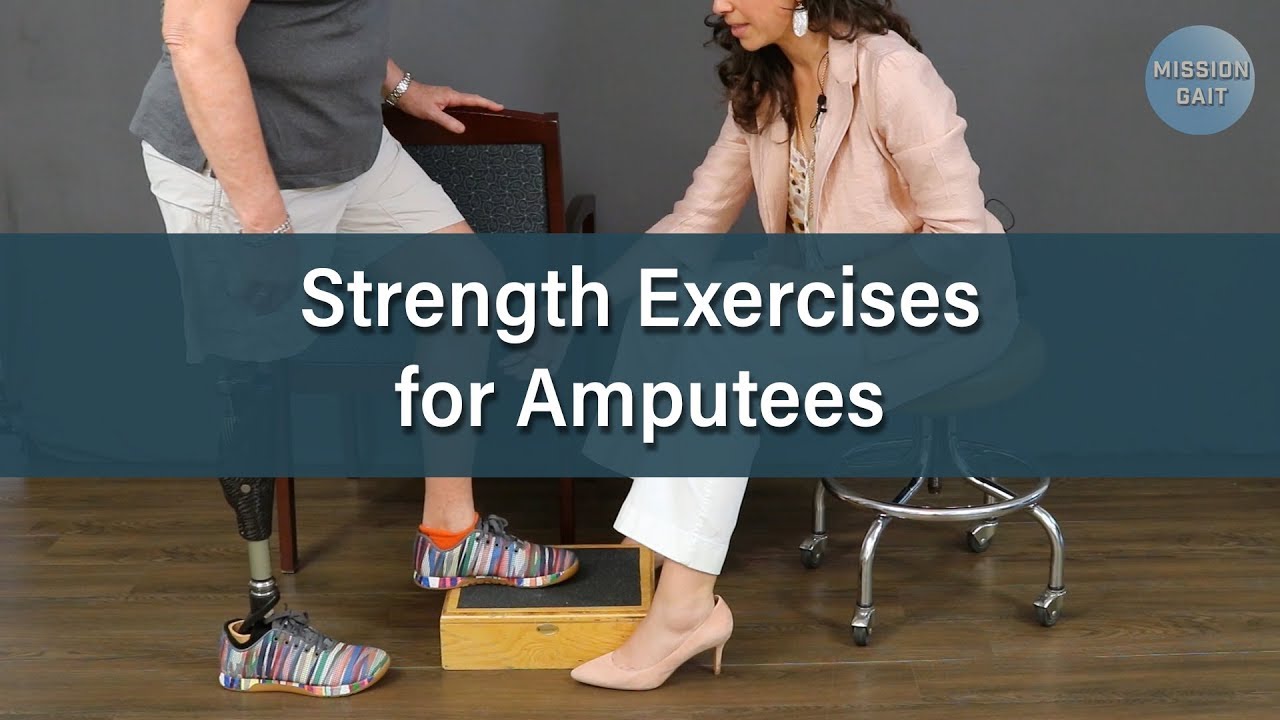
- Stepping stool/stair stepping: Step with a sound leg onto a low stool while holding onto supports; practice descending.
- Forward stepping/load shifting: Step forward with the sound leg while consciously loading weight on the prosthetic side.
- Figure-8 walking/turning drills: Walk in curved paths or figure-8 shapes to practice directional changes.
- Heel-toe walking: Place the heel of the prosthetic foot, then the sound foot ahead; walk slowly with precise control.
- Obstacle crossing/hurdle steps: Step over small objects (e.g., books, cones) to simulate real-world perturbations.
- Ramp/incline walking (if accessible safely): Begin with small slopes and progress carefully.
- Weight carrying while walking: Practice walking with light objects (e.g. small bag) to engage balancing under load.
As you improve, reduce reliance on supports (e.g., switch from walker → cane → unaided) in these drills.
4. Flexibility / Mobility & Residual Limb Care
Maintaining mobility and a comfortable residual limb-socket interface is vital to long-term success.
- Hamstring stretches: As in the below-knee program, lie supine, bring the sound leg up, and extend the prosthetic leg until the stretch is felt.
- Hip flexor stretch: Lie supine, bring non-amputated leg to chest and gently press prosthetic side limb toward extension (or dangle over edge).
- Adductor/inner thigh stretch: Seated, separate legs and lean torso control to gently stretch inner thighs.
- Residual limb desensitization/scar mobilization: Gentle massage, stroking, or soft brushes to reduce hypersensitivity.
- Socket/liner hygiene: Wipe inner surfaces, check for residue, maintain clean contact.
- Skin inspection/mirror checks: Use a mirror to check pressure spots, redness, and blisters on your residual limb daily.
Consistent flexibility work prevents contractures, improves comfort, and complements strength work to enable full movement.
Sample Weekly Home Exercise Schedule
Here’s a sample week to balance variety, rest, and progression:
| Day | Weight Shift / Balance | Strength / Core | Gait Drills / Functional | Stretch / Mobility |
|---|---|---|---|---|
| Monday | Lateral & forward shift + single-leg stance | Bridges, quad sets, bird dog | Stepping stool drills | Hamstring, hip flexor stretches |
| Tuesday | Clock reach, balance board | Hip abduction, hip extension | Figure-8 walking | Adductor stretch, phantom limb desensitization |
| Wednesday | Rest / lighter session | Core hold, plank | Heel-toe walking, obstacle steps | Stretch & residual limb inspection |
| Thursday | Weight shift (reduced support) | Single-leg deadlift, quad sets | Ramp/incline walking, turning | Stretch, scar mobilization |
| Friday | Full balance session | Hip extension, core | Weight-carry walking | Mobility & skin care |
| Saturday | Mix of balance + shifting | Mix strength sets | Free walking around the home environment | Comfort stretching |
| Sunday | Recovery / light mobility work | Gentle core activation | Walking for a distance challenge | Review skin, residual limb |
Adjust frequency and load based on fatigue, soreness, or feedback from your clinician.
Progression & Adaptation Tips
- Increase difficulty gradually: Add repetitions, reduce hand support, rise onto softer surfaces, or combine tasks (e.g., balance + reach).
- Incorporate dual tasks: Once comfortable, add cognitive tasks while balancing (e.g., naming objects, simple math) to simulate real-world demand.
- Vary surfaces: Transition from hard floor → carpet → foam pad → outdoor surfaces.
- Monitor energy levels: As stamina improves, extend walking or gait training time.
- Use feedback tools: Scales, video recordings, pressure sensors, or wearable motion tools can help track symmetry or weight shift.
- Alternate days: Avoid overuse. If one day is intense, the next can be lighter.
- Adjust for residual limb volume changes: If your limb swells or shrinks, your fit may shift; adapt fit or liner temporarily to avoid skin damage.
Safety & Cautions
- Always have a stable support or assistance when doing balance work, especially early on.
- Use proper footwear and ensure your prosthesis is well-aligned before starting gait drills.
- Avoid sudden jerky movements—progress slowly.
- Watch for skin irritation—redness, pain, blistering—and pause if they occur.
- If severe pain, dizziness, or fall risk emerges, stop and contact your care team.
- Tailor based on your overall health, comorbidities, cardiovascular status, and physician guidance.
- Use assistive devices (cane, walker) until you’re safe to proceed without them.
Realistic Expectations & Benefits
- Consistent home exercise won’t make you an elite athlete overnight, but it does improve balance, confidence, walking smoothness, endurance, and safety.
- Even small gains in gait symmetry or proprioception reduce compensatory strain on the sound limb and spine.
- Over time, you may reduce reliance on assistive aids, negotiate more diverse terrain, and expand your daily mobility.
- The mental benefit of self-managed progress often boosts compliance, mood, and engagement in your rehabilitation.
Final Thoughts
Incorporating home exercises for prosthetic users is one of the most powerful tools you have in your rehabilitation toolkit. Done thoughtfully, consistently, and safely, these routines build confidence, reduce complications, and help your prosthetic limb feel more like a natural extension than an external aid. If you’re looking for guidance on customizing a home program or refining your prosthetic fit, our team at Orthotics Ltd. is here to support your mobility forward. Contact us today!Frequently Asked Questions
1. How often should I do home exercises with my prosthesis?
Aim for 5 to 7 sessions per week, even if some days are shorter or lighter. Consistency matters more than intensity, especially early.
2. When can I stop using hand support for balance exercises?
Once you can reliably maintain balance with minimal hand support for 20–30 seconds, without wobble or pain, you may gradually reduce support—but under supervision.
3. Can I exercise with both limbs (prosthetic and sound) together?
Yes. Even when your focus is strengthening around the prosthesis, training the sound limb, core, and contralateral movements helps overall balance and symmetry.
4. What if I notice pain or redness on the residual limb?
Pause that exercise, reduce usage, and inspect the area carefully. If redness persists or blisters form, consult your prosthetist or therapist before resuming.
5. How long until I see improvement?
While individual progress varies, many users begin noticing better balance or smoother gait within 2–4 weeks. Greater strength, walking endurance, and control may take months.
Sources:
- https://www.physioinq.com.au/blog/exercises-for-amputee-rehabilitation
- https://livingwithamplitude.com/shoes-for-amputees-shopping-tips/
- https://www.mkuh.nhs.uk/patient-information-leaflet/exercises-for-below-knee-amputees
