

Orthotic Bracing After a Stroke: A Recovery Roadmap

Key Highlights
- Orthotic bracing, most often an AFO (ankle-foot orthosis), is a common and important part of stroke recovery, helping patients walk safely while their brain and body rebuild the connections weakened by the event.
- The right brace changes as recovery progresses: an off-the-shelf AFO in the acute stage, a custom AFO once swelling and stroke gait patterns stabilize, and sometimes a more advanced device like a KAFO for patients with knee instability.
- Bracing doesn’t replace physical therapy. It works alongside it, enabling earlier, safer walking after stroke, which itself drives faster neurological recovery.
- Timing matters. Earlier bracing intervention is generally associated with better mobility outcomes; waiting too long can entrench compensatory patterns that are harder to undo later.
- Outcomes vary widely, and both are normal. Some patients gradually wean off their brace as motor function returns, while others use it long-term to maintain their hard-won mobility.
- Caregivers play a critical role in the bracing process, from helping with daily putting-on and taking-off to performing skin checks and recognizing when adjustments are needed.
To the Family Caregiver
If you’re reading this in the days or weeks after a loved one’s stroke, you are almost certainly tired. The hospital stay went by in a blur. Discharge happened faster than you expected. Somewhere along the way, a physical therapist or doctor mentioned the word “AFO,” handed your family member a plastic brace, and showed you how to strap it on — probably with less explanation than you would have wanted.
You’re not alone in feeling overwhelmed. Bracing is often introduced quickly during stroke recovery, partly because the priority in those first weeks is getting the patient up and moving safely, and partly because the people explaining it work with these devices every day and forget how unfamiliar they are to everyone else. This post is written for you — the spouse, the adult child, the friend who’s now learning to be a part-time nurse — to give you the context that gets skipped in those first conversations.
The short version is this: bracing after a stroke is rarely permanent, often genuinely helpful, and almost always part of a bigger picture that includes physical therapy, time, and patience. Here’s what to know about how it fits in.
Why Orthotics Matter in Stroke Recovery
A stroke interrupts the brain’s connection to one side of the body, leaving the affected side weak, partially paralyzed, or moving in unfamiliar ways. This pattern, called hemiparesis, often shows up in the foot and ankle. The patient can’t reliably lift the front of the foot during walking (drop foot), the ankle rolls or buckles under their weight, and the knee sometimes hyperextends or gives way. The leg becomes unsafe to walk on, even when the patient has the strength and the will to try.
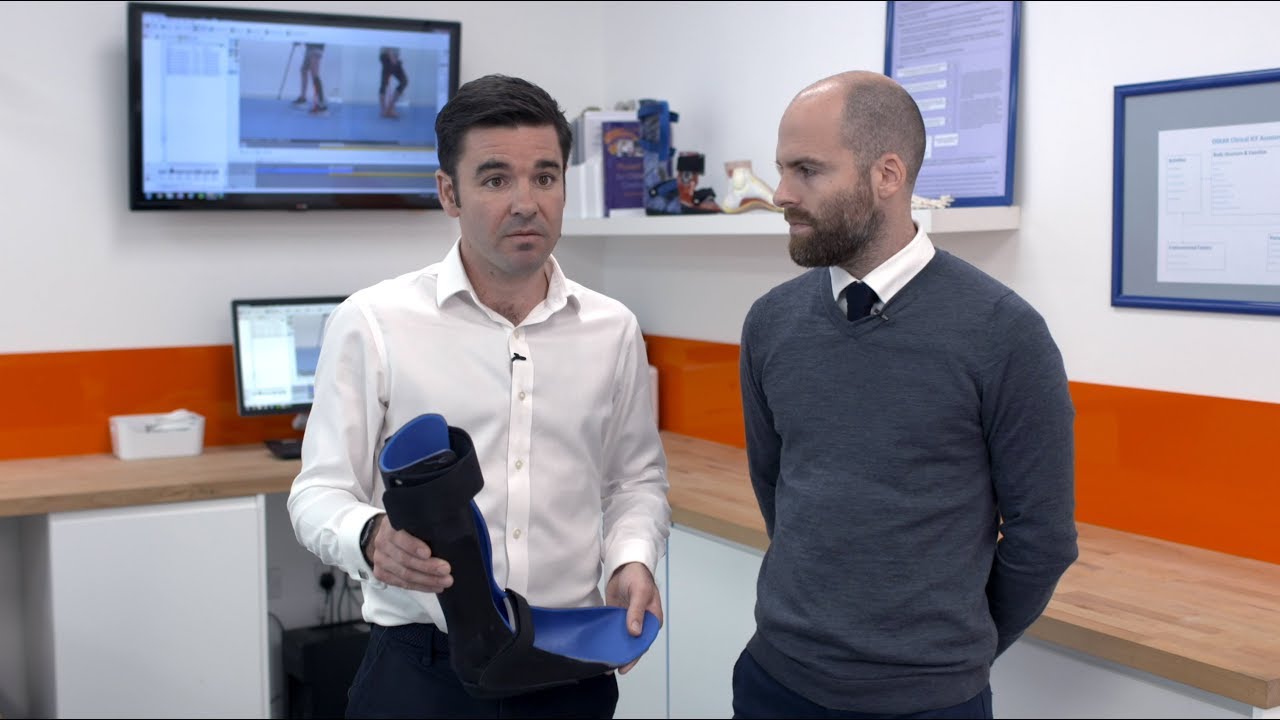
This is where bracing earns its place in stroke recovery. An orthotic, or an AFO specifically, after stroke stabilizes the ankle, holds the foot in a safer position, and gives the leg a predictable structure to step onto. With that support in place, patients can practice walking sooner, take more steps per therapy session, and build endurance, all of which encourage the brain to rewire and reclaim function. The research is consistent on this point: walking, repeated walking, is one of the most powerful drivers of post-stroke neurological recovery. Bracing isn’t a substitute for that work. It’s what makes the work possible in the first place.
There’s also a safety dimension that matters enormously. Falls are one of the most serious risks after a stroke. A patient who falls in the early weeks can fracture a hip, hit their head, lose confidence, and stall their rehabilitation for weeks or months. Orthotic bracing reduces fall risk in a tangible, immediate way.
The Bracing Options at Each Recovery Stage
Stroke recovery is not a single moment—it unfolds in stages, and the right brace at one stage may not be the right brace six months later. A good orthotic plan evolves with the patient.
1. Acute and Early Recovery: Off-the-Shelf AFO
In the first weeks after a stroke, things are still changing fast. Swelling fluctuates. Muscle tone is unpredictable. The patient may be using the affected leg one day in ways they couldn’t the previous day. During this period, an off-the-shelf AFO, a pre-made plastic brace in standard sizes, is usually the right starting point. It provides immediate stability, it’s inexpensive, and it doesn’t require a long fabrication wait. Hospitals and rehabilitation centers often issue these directly so the patient can begin gait training without delay.
The off-the-shelf brace isn’t meant to be the patient’s long-term solution. It’s a starter device, the equivalent of a temporary cast before more permanent care.
2. Subacute Recovery: Custom AFO
Once swelling has stabilized and a more consistent walking pattern starts to emerge, usually around 6 to 12 weeks post-stroke, though this varies considerably, it’s time to consider a custom AFO. A custom device is molded to the patient’s actual leg, sized to their specific anatomy, and built around the gait patterns they’re developing. Off-the-shelf braces almost always create some pressure points or fit compromises; custom devices solve these and tend to be tolerated much better for long-term wear.
This is also the stage where the orthotist can begin matching the type of AFO to the patient’s residual function rather than just providing generic stability.
3. Chronic Recovery: Tailored to Residual Function
By six months or so post-stroke, the patient’s recovery trajectory becomes clearer. Some have regained significant ankle control. Some have plateaued with persistent drop foot. Others have developed spasticity that pulls the foot into a difficult position. The bracing strategy at this stage gets more specific:
- Custom solid AFO: for patients with significant spasticity, severe weakness, or instability that requires firm control of the ankle.
- Articulated (hinged) AFO: for patients who have regained some ankle motion but still need help lifting the foot, this design preserves more natural walking mechanics.
- Carbon fiber AFO: for patients who have done well in their recovery, are active, and want a lighter, energy-returning device that supports longer walking and an easier return to community life.
4. Severe Weakness: KAFO
For a smaller subset of stroke patients, the weakness extends above the ankle. The knee may buckle, hyperextend, or fail to support body weight. In these cases, an AFO alone isn’t enough—a KAFO (knee-ankle-foot orthosis) is needed. A KAFO extends up the thigh and provides knee stability in addition to ankle support. It’s a more substantial device, requires more adjustment time, and is reserved for situations where ankle bracing alone won’t allow safe walking. Many patients who start with a KAFO for stroke recovery eventually step down to an AFO as their quadriceps strength returns.
Quick Reference
| Stage | Time Frame | Typical Bracing | Goal |
|---|---|---|---|
| Acute/Early | Discharge to ~6–12 weeks | Off-the-shelf AFO | Immediate stability, start gait training |
| Subacute | ~6 weeks to 6 months | Custom AFO | Better fit, accommodate emerging gait |
| Chronic | 6 months and beyond | Custom solid, articulated, or carbon fiber AFO | Match device to residual function |
| Severe weakness | Any stage if knee unstable | KAFO | Knee and ankle support for safe walking |
How Bracing Fits Into Rehabilitation
A point worth emphasizing for families: bracing works with physical therapy, not instead of it. The brace doesn’t replace muscle strength, retrain the brain, or rebuild balance. What it does is create the conditions under which the patient can do the work of rehabilitation safely and productively.
A physical therapist using an AFO can have the patient stand longer, take more steps, attempt stairs sooner, and work on weight-shifting drills that would be too risky without the support. Over time, those repetitions add up. The brain reorganizes. Some patients regain enough function that the brace becomes less necessary; some maintain their gains by continuing to wear it.
Coordination between the rehab team and the orthotist matters here. A good orthotist communicates with the physical therapist and neurologist to ensure the brace is supporting, not interfering with, the recovery plan. If a patient’s gait changes significantly between visits, the brace may need to be modified. This back-and-forth is expected.
Realistic Expectations
This is the part of the conversation that families often want to have but feel hesitant to ask about. The honest answer is that stroke recovery outcomes vary widely, and what’s “normal” covers a very broad range.
Some patients use a brace temporarily, gradually transition to a lighter device, and eventually wean off entirely as their motor function returns. This is more common in patients with milder strokes, in younger patients, and in those who engage consistently with rehabilitation.
Some patients use a brace long-term, sometimes indefinitely, and live full, active lives with it. The brace becomes a daily tool, like glasses for someone with imperfect vision, that lets them do the things that matter to them.
Both outcomes are normal. Neither represents failure. The goal of bracing isn’t to escape the device as quickly as possible; it’s to maximize the patient’s safe mobility, whatever that looks like over time.
In our sessions, we’ve seen the full range. One patient, a man in his late sixties who had a stroke that left him with significant left-sided weakness, started with a basic off-the-shelf AFO at discharge. Over four months, he progressed to a custom articulated AFO, and after another six months of consistent physical therapy, he was walking short distances around his home without it. He still wears it for community outings, longer walks, and uneven terrain. His wife, who learned to help him put the brace on every morning, told us at his last fitting that she’d come to think of it as “the thing that gave us back our walks together.” That’s the kind of outcome bracing is meant to support.
Why Timing Matters
If there’s one practical message worth driving home, it’s that earlier orthotic intervention is generally associated with better outcomes. Two reasons:
First, the brain is most plastic, most capable of rewiring, in the first months after a stroke. Walking practice during this window has an outsized impact, and that practice depends on being able to walk safely. A patient who waits months for bracing loses critical rehabilitation time.
Second, when patients walk without proper support, they develop compensatory patterns. They hike the hip to clear the dragging foot. They swing the leg outward. They lean on the unaffected side. These habits become entrenched, and once entrenched, they’re harder to undo even when proper bracing is eventually introduced. Early bracing helps the patient develop a healthier gait pattern from the start.

What to Expect at the Orthotist Visit
A stroke-related orthotic evaluation is more involved than a routine appointment. Expect the following:
- Communication with the rehab team. The orthotist will typically want to review records or speak with the patient’s neurologist and physical therapist to understand the recovery plan.
- Detailed assessment. Range of motion at the ankle, strength testing, skin condition, sensation, and gait observation — even a few steps with a walker — give the orthotist what they need to choose the right device.
- Casting or 3D scanning. A precise mold of the leg is captured for fabrication.
- Fabrication. Custom devices typically take 1–3 weeks to build.
- Fitting and education. The patient and caregiver are taught how to put the brace on, take it off, check the skin, and identify warning signs.
- Adjustments and follow-up. Especially during the first few months post-stroke, devices often need modification as recovery progresses. This isn’t a sign of failure — it’s a sign that the patient is changing, which is usually a good thing.
For Caregivers: Practical Tips
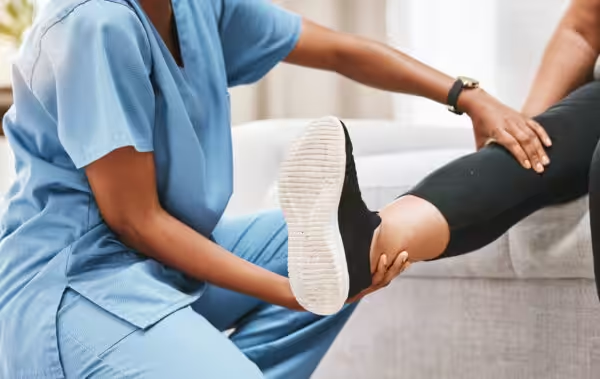
Family caregivers do a lot of the day-to-day work of bracing, and a few things make it easier.
- Donning and doffing. Putting the brace on is easier when the patient is seated, the foot is at a neutral angle, and a thin sock is in place. Slip the foot into the brace first, then into the shoe. Removing the brace at night should also be a chance to inspect the skin.
- Skin checks. Look at the skin every time the brace comes off, especially in the first weeks. Any red mark that doesn’t fade within 20–30 minutes needs attention. Patients with reduced sensation on the affected side may not feel a pressure point developing, which makes your visual check important.
- Shoes. The braced foot usually needs a shoe that’s half a size to a full size larger, with a removable insole. Velcro closures are easier than laces.
- When to call. Persistent redness or blisters, the brace feeling looser or tighter than before, new pain, changes in walking ability, or any concerns about fit are all reasons to call the orthotist. Don’t wait until the next scheduled appointment if something seems off.
Walking Together Through Recovery
Stroke recovery is a long road, and orthotic bracing is one of the tools that helps make the journey safer, faster, and more hopeful. The right brace at the right stage, combined with consistent rehabilitation and the steady support of family, can make the difference between a patient who’s afraid to walk and one who’s regaining their footing in the world.
At Orthotics Ltd., we work alongside stroke rehab teams across New York to provide thoughtful, individualized bracing for patients at every stage of recovery, or even after surgery. Our clinicians coordinate with neurologists, physical therapists, and families, and we take the time to understand not just the diagnosis but the person, what they hope to get back to, what makes the device hard to wear, and what would make their daily life easier. We adjust the brace as recovery evolves, because what works in month two often isn’t what’s needed in month six. Our New York clinics serve patients and families across the region, and we’re committed to being part of your team for as long as you need us. Contact us today to schedule an evaluation and to take the next step on the road forward together.
Frequently Asked Questions
1. When should an AFO be introduced after a stroke?
Generally, the patient is medically stable and begins gait training — often within the first one to two weeks. Early bracing supports earlier walking, which drives recovery. If your loved one was discharged without one or with a poorly fitting device, an orthotic evaluation is worth pursuing without delay.
2. How long will my loved one need to wear it?
This depends on the severity of the stroke and the trajectory of recovery. Some patients wear an AFO for a few months as a transitional aid. Others wear it long-term. There’s no single timeline, and the answer often becomes clearer over the first six to twelve months of rehabilitation.
3. Can a stroke patient learn to walk without bracing?
For some, yes, particularly those with milder strokes who recover significant motor function. For others, the brace remains an important part of safe mobility. Both paths are common, and the goal is maximum safe function rather than independence from the device for its own sake.
4. Does Medicare cover orthotic bracing after a stroke?
Medicare Part B typically covers medically necessary orthotic devices, including custom AFOs, when prescribed by a physician for a qualifying diagnosis like post-stroke hemiparesis brace. Coverage details, deductibles, and supplier requirements vary, and a good orthotist can help navigate the documentation process. Many private insurers and Medicaid plans also provide coverage under similar circumstances.
5. What if my loved one refuses to wear the brace?
This is more common than people realize, especially when the brace is uncomfortable, unfamiliar, or feels like a public marker of disability. Most of the time, refusal points to a fit issue or an emotional adjustment issue, both of which are addressable. A return visit to the orthotist often resolves the physical problems, and conversations with the rehab team can help with the emotional side. Don’t accept “they just won’t wear it” as the end of the story.
Sources:
- https://www.hopkinsmedicine.org/health/conditions-and-diseases/stroke/stroke-recovery-timeline
- https://www.stroke.org/en/life-after-stroke/recovery
- https://www.neurolutions.com/after-stroke/how-leg-and-foot-orthotics-can-help-stroke-survivors-regain-mobility/
- https://pmc.ncbi.nlm.nih.gov/articles/PMC9981677/
- https://pmc.ncbi.nlm.nih.gov/articles/PMC10192684/
