

Plantar Fasciitis: When OTC Insoles Stop Working and Custom Orthotics Take Over
Key Highlights
- Plantar fasciitis affects roughly 1 in 10 adults at some point in their lives, and its signature symptom is sharp heel pain with the first few steps in the morning that fades with movement, then returns by evening.
- The condition is caused by inflammation and tiny tears in the plantar fascia, the thick band of tissue running from your heel to your toes, and overnight tightening is what makes those first morning steps so painful.
- A conservative plantar fasciitis treatment ladder (stretching, OTC inserts, night splints, ice, anti-inflammatories) resolves most cases, but when these steps stall after several weeks, custom orthotics for plantar fasciitis are the logical next move.
- Over-the-counter insoles often fail because generic arch support doesn’t match individual foot mechanics, and cushioning alone doesn’t address the underlying biomechanical cause.
- Custom orthotics work by offloading the painful fascia insertion point, providing targeted arch support, stabilizing the heel with a deep cup, and correcting the overpronation that often drives the condition.
- Most patients feel meaningful improvement within 2–6 weeks of consistent wear; some take up to three months, and a small percentage require more aggressive interventions like physical therapy, shockwave therapy, or cortisone injections.
The Pain You Recognize the Moment You Stand Up
You know the pain by now. The stabbing sensation in your heel when your foot hits the floor in the morning, like stepping on a tack. After a few minutes of moving around, it fades. You convince yourself it’s nothing. But by the time you’re home from work and finally sitting down, it’s back, throbbing through the bottom of your foot. The next morning, the cycle starts again.
That pattern is the unmistakable signature of plantar fasciitis, and it’s one of the most common foot complaints in adult patients. Roughly 10% of people will experience it at some point. Runners get it. People who stand on hard floors all day get it. People who suddenly increase their activity get it. People who do nothing different at all sometimes get it too.
The encouraging news is that most cases of plantar fasciitis resolve with conservative treatment. The harder truth, the one many sufferers learn after months of buying drugstore inserts that don’t quite work, is that when basic interventions stall out, the path forward usually involves something more tailored. This post walks through that journey: what plantar fasciitis actually is, why morning heel pain is so distinctive, what to try in order, and when over-the-counter insoles need to give way to custom support.
What Plantar Fasciitis Actually Is
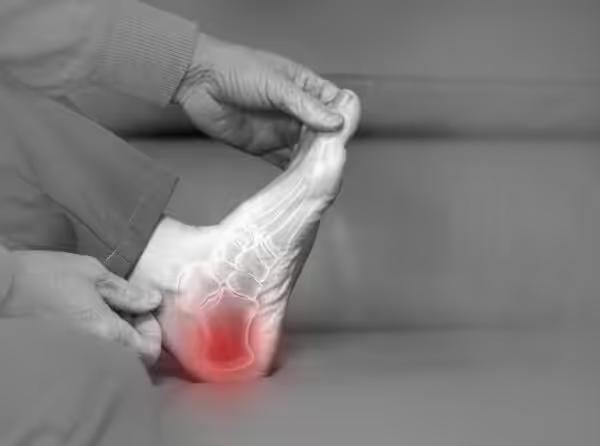
The plantar fascia is a thick, fibrous band of connective tissue that runs along the bottom of your foot, anchoring at the heel bone and fanning out toward the base of your toes. It functions like a bowstring, taut and supportive, helping maintain the arch and absorb the impact of every step. Plantar fasciitis occurs when that band becomes inflamed and develops small tears, usually near where it attaches to the heel. It’s fundamentally an overuse injury, even when the “overuse” isn’t dramatic. Repeated tension, poor mechanics, sudden activity changes, or simply too many hours on hard surfaces can all push the fascia past what it can recover from overnight.
Why Morning Heel Pain Is the Giveaway
If there’s one symptom that virtually clinches the diagnosis, it’s plantar fasciitis heel pain. Here’s why it happens.
While you sleep, your feet rest in a relaxed, slightly pointed position. In that position, the plantar fascia shortens and partially heals, and the micro-tears begin to knit themselves back together overnight. Then you stand up in the morning and load your entire body weight onto a fascia that has just barely started repairing itself. Those first few steps re-tear the tissue, and your nervous system responds with the sharp, stabbing pain that plantar fasciitis sufferers know all too well.
As you walk, the fascia stretches and warms up, the acute pain subsides, and you go about your day. But the cumulative load eventually catches up with you. By late afternoon or evening, the inflammation has built back up, and the pain returns, often more dull and aching than sharp.
This pattern of “worst in the morning, eases with movement, returns with fatigue” is so consistent that any clinician hearing it will think plantar fasciitis first. If your heel pain doesn’t follow this pattern, it’s worth asking whether something else might be going on. Nerve entrapment, a stress fracture, or a fat pad issue can all mimic plantar fasciitis but require different treatment.
The Conservative Treatment Ladder
Most cases of plantar fasciitis don’t require advanced intervention. The starting point is a tiered approach, working from the least invasive to the most:
| Step | Treatment | What It Does | Realistic Timeframe |
|---|---|---|---|
| 1 | Stretching (calf, Achilles, plantar fascia) | Reduces tension on the fascia | 4–8 weeks |
| 2 | OTC arch-support insoles | Provides basic cushioning and support | 2–6 weeks of trial |
| 3 | Plantar fasciitis night splint | Keeps the fascia gently stretched overnight to prevent morning re-tearing | 4–8 weeks |
| 4 | Ice and anti-inflammatories | Reduces inflammation and acute pain | Symptomatic relief |
| 5 | Activity modification | Reduces load on the fascia during healing | Ongoing |
| 6 | Custom orthotics | Targeted, biomechanically corrective support | 2–12 weeks |
| 7 | Physical therapy, shockwave, injections | Addresses cases unresponsive to the above | Case-dependent |
For most people, steps 1 through 5 are enough. Stretch your calves daily, roll a frozen water bottle under your foot, wear a night splint for a few weeks, switch from flat shoes to something supportive, and the problem fades over a couple of months.
But for a meaningful subset of patients, that ladder stalls somewhere in the middle. The stretches help a little. The drugstore inserts feel okay for a week or two and then plateau. The night splint helps with the morning pain, but the evening pain stays. The condition becomes chronic, defined as lasting longer than three months, and it’s at this point that custom orthotics for plantar fasciitis become the natural next step.
Why Over-the-Counter Insoles Often Fall Short
There’s nothing wrong with starting with over-the-counter insoles. They’re inexpensive, accessible, and they genuinely work for plenty of people. But they have predictable limitations that explain why they fail in the more stubborn cases.
The first issue is fit. Generic arch supports are designed around an average foot shape. If your arch is higher, lower, longer, or shorter than that average, the peak of the insole won’t sit where your arch actually is. The result is either inadequate support (the arch peak is too far forward or backward to do anything useful) or active discomfort (the peak presses into a spot that isn’t your arch and creates a new pressure point).
The second issue is depth. Most over-the-counter plantar fasciitis insoles use a relatively shallow heel cup. A shallow heel cup doesn’t stabilize the calcaneus, the heel bone, well enough to reduce the tugging at the fascia insertion point. And that insertion point is exactly where the pain is.
The third issue is correction. Plantar fasciitis is rarely just about the heel. It’s often driven by overpronation, the inward rolling of the ankle that flattens the arch and overstretches the fascia with every step. Off-the-shelf insoles add cushioning, but they don’t actively correct mechanics. Without addressing the pronation, you’re treating the symptom while the cause keeps producing it.
In our sessions, we’ve seen this pattern play out repeatedly. One patient — a postal worker walking eight to ten miles per shift—had cycled through three different brands of drugstore plantar fasciitis insoles over a year. Each gave him a couple of weeks of partial relief before the pain returned. A gait analysis revealed significant overpronation on the affected side that none of his insoles addressed. Within five weeks of wearing custom orthotics built around his actual arch shape and posted to correct the pronation, his morning heel pain was reduced by roughly 70%. By twelve weeks, he reported it was essentially gone. The drugstore over-the-counter inserts weren’t bad products—they just weren’t doing the job his foot specifically needed done.
What Custom Orthotics Do Differently
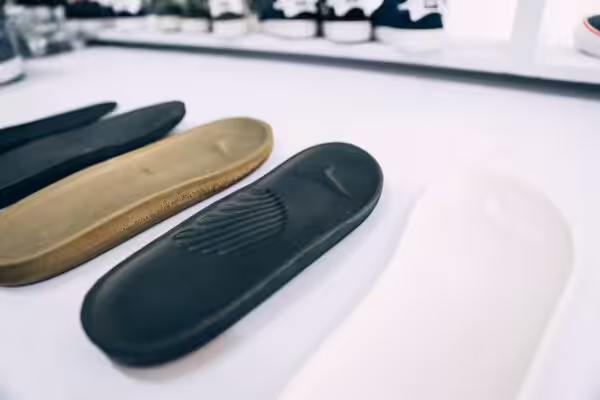
Custom orthotics for plantar fasciitis work in several specific ways that off-the-shelf inserts can’t replicate.
- Targeted arch support. A custom orthotic places the arch peak exactly where your arch sits, providing support without creating new pressure points. The height and shape of the arch are matched to your foot, not to a population average.
- Deep heel cup. A well-designed custom orthotic uses a deep, contoured heel cup that cradles the calcaneus and keeps it from rolling or shifting during gait. Stabilizing the heel reduces the repeated tugging on the fascia insertion point, which is the most painful spot in the condition.
- Offloading the fascia insertion point. Some custom orthotics incorporate a heel pad cutout or a soft inlay directly beneath the painful area, redistributing pressure away from the inflamed tissue while the rest of the foot remains supported.
- Addressing overpronation. Through subtle wedging, called posting, under the heel and sometimes the forefoot, a custom orthotic gently guides the foot into a more neutral position throughout the gait cycle. This reduces the stretching force on the fascia with every step.
- Even pressure distribution. Rather than letting load concentrate at the heel or arch, a properly built orthotic spreads pressure across the entire foot, reducing the cumulative strain that contributes to recurrence.
The combined effect is that the fascia gets the rest it needs to heal, not by removing you from your life, but by changing the way force travels through your foot during every step you take.
If you’re curious about what a fitting actually involves or what to expect during the break-in period, our post on why your orthotics hurt covers the common adjustment phase, and the broader orthotics services page explains how the evaluation and fabrication process works.
Realistic Timelines: When You’ll Feel the Difference
This is where honesty matters. Custom orthotics aren’t a same-day fix for plantar fasciitis. The fascia has been under strain for weeks or months, and it needs time to heal — even after the mechanical cause has been corrected.
Most patients feel meaningful improvement within 2–6 weeks of consistent wear. Morning pain tends to ease first, often noticeably reduced within the first month. Evening fatigue pain typically takes longer to resolve, sometimes a full 8–12 weeks.
A small percentage of patients, usually those with long-standing chronic cases or significant biomechanical issues, may take up to three months to feel substantial relief. And it has to be said honestly: not everyone responds to orthotics alone. Roughly 80–90% of patients with conservative treatment (including orthotics) will recover, but that leaves a real minority who need more.
If you’ve worn properly fitted custom orthotics consistently for three months and the pain hasn’t meaningfully improved, that’s information. It tells your clinician that the next step on the ladder may be needed.
When Orthotics Aren’t Enough
For the cases that don’t respond, the next tier of treatment is typically a combination of:
- Physical therapy. Targeted strengthening of the foot intrinsic muscles, the calf complex, and the hip stabilizers can change the loading pattern on the fascia in ways that orthotics alone cannot.
- Cortisone injections. A single corticosteroid injection into the fascia can break a cycle of chronic inflammation. They’re used sparingly because repeated injections can weaken the fascia and risk rupture.
- Extracorporeal shockwave therapy (ESWT). Sound waves delivered to the inflamed tissue stimulate healing in cases that have plateaued. It’s non-invasive and has good evidence for chronic plantar fasciitis.
- Platelet-rich plasma (PRP) injections. A newer option is using the patient’s own concentrated growth factors to promote tissue healing.
- Surgery. Reserved for the small percentage of cases that fail every other intervention after 6–12 months of consistent treatment. A plantar fascia release procedure is uncommon and considered a last resort.
The signs that you may be heading toward this tier include pain that hasn’t budged after three months of orthotic use, pain that’s worsening rather than improving, pain that’s spreading to new areas, or significant impact on your ability to work or sleep.
Get a Proper Evaluation for Persistent Heel Pain
Plantar fasciitis can be deeply frustrating, especially when you’ve already tried the stretches, the drugstore insoles, the night splint, and the ice — and that stabbing morning pain still hasn’t gone anywhere. The encouraging reality is that for the cases where over-the-counter solutions stall out, custom orthotics built around your actual foot mechanics often provide the breakthrough patients have been looking for. They don’t just cushion the pain; they correct the load pattern that’s been creating it.
At Orthotics Ltd., we specialize in custom orthotics for plantar fasciitis, designed and fitted by experienced clinicians who take the time to perform a gait analysis, scan your feet accurately, identify the contributing factors specific to your case, and follow up to make sure the fit is right. We’ve helped patients across a wide range of situations, from runners trying to get back to training, to teachers and nurses on their feet all day, to people who have lived with chronic heel pain for years and were told to “just stretch more.” Book a plantar fasciitis evaluation at our New York clinics and find out whether custom support could finally be the step that breaks the cycle. Contact us today to schedule your appointment.
Frequently Asked Questions
1. How long does plantar fasciitis last?
For most people with prompt and consistent treatment, plantar fasciitis resolves within 6–12 months. Many feel substantial improvement well before that, often within 2–3 months of starting effective treatment. Chronic cases, those lasting longer than a year, exist but are the minority, and they almost always involve some combination of delayed treatment, inconsistent adherence, or unaddressed biomechanical factors.
2. Can I run with plantar fasciitis?
The honest answer is: usually not at full volume. Continuing to run on an actively inflamed fascia tends to prolong the condition and can occasionally lead to a partial tear. Most clinicians recommend reducing mileage significantly, switching to lower-impact cross-training (cycling, swimming, elliptical), and only returning to running after the morning pain has substantially resolved. Custom orthotics can often shorten the layoff considerably.
3. Will insurance cover custom orthotics for plantar fasciitis?
Coverage varies widely by plan. Many insurance providers cover custom orthotics when prescribed for a diagnosed medical condition like plantar fasciitis, but specific requirements (documentation, prior conservative treatment, in-network providers) differ. It’s worth verifying coverage with your insurer before your appointment, and a good clinic can help you understand what documentation is typically required.
4. Is plantar fasciitis the same as a heel spur?
They’re related but not identical. A heel spur is a small bony growth on the underside of the heel bone, often formed as a response to long-standing tension from the plantar fascia. Many people with plantar fasciitis have heel spurs visible on imaging, and many people without any pain at all also have heel spurs. The spur itself usually isn’t the cause of pain — the inflamed fascia is. Treatment focuses on the fascia, not the spur.
5. What kind of shoes should I wear with plantar fasciitis?
Look for shoes with good arch support, a moderately cushioned heel, and a firm sole that doesn’t bend easily in the middle of the shoe. Avoid completely flat shoes, worn-out sneakers, and going barefoot on hard floors, all of which place maximum strain on the fascia. Many patients find that a slight heel-to-toe drop (around 8–12 millimeters) feels more comfortable than zero-drop shoes during recovery.
Sources:
- https://health.ucdavis.edu/blog/cultivating-health/plantar-fasciitis-how-is-it-treated-and-whos-at-risk/2022/07
- https://my.clevelandclinic.org/health/diseases/14709-plantar-fasciitis
- https://www.health.harvard.edu/pain/plantar-fasciitis-symptoms-causes-and-treatments
- https://my.clevelandclinic.org/health/diseases/22474-overpronation
- https://pmc.ncbi.nlm.nih.gov/articles/PMC3687890/
