

Common Challenges with Partial Foot Amputations
Key Highlights
- Partial foot amputations affect balance, gait, and stability more than many people expect.
- Pain, pressure points, and skin breakdown are common challenges without proper support.
- Prosthetic and orthotic solutions play a critical role in restoring function and preventing complications.
- Footwear limitations and uneven limb loading can impact long-term joint health.
- Early intervention and proper prosthetic care improve mobility, comfort, and independence.
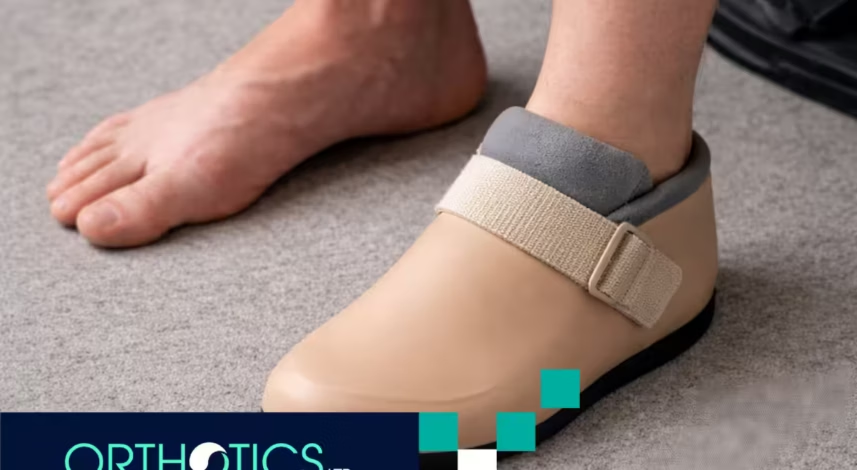
A partial foot amputation—such as the loss of toes, the forefoot, or part of the midfoot—can significantly affect how a person stands, walks, and moves. While it may preserve more of the limb compared to higher-level amputations, it also presents unique challenges that are often underestimated.
Individuals with partial foot amputations frequently experience changes in balance, gait mechanics, pressure distribution, and overall mobility. Without proper support, these challenges can lead to pain, instability, and long-term musculoskeletal issues.
Understanding the most common challenges with partial foot amputations is an essential step toward finding effective prosthetic and orthotic solutions that improve comfort, function, and quality of life.
What Is a Partial Foot Amputation?
A partial foot amputation involves the removal of a portion of the foot while preserving the ankle joint. Common types include:
- Toe amputations
- Transmetatarsal amputations (across the ball of the foot)
- Lisfranc amputations (midfoot)
- Chopart amputations (hindfoot)
While preserving limb length can be beneficial, the loss of key structures that contribute to balance and propulsion creates functional challenges that require specialized care.
Loss of Push-Off Power
Why Push-Off Matters
During normal walking, the forefoot and toes play a major role in:
- Propelling the body forward
- Stabilizing the foot during stance
- Maintaining a smooth walking pattern
A partial foot amputation reduces or eliminates this push-off phase, forcing the body to compensate.
Common Effects
- Shorter step length
- Slower walking speed
- Increased energy expenditure
- Overuse of the opposite limb
Without proper prosthetic support, walking can become inefficient and tiring.
Balance and Stability Challenges
Reduced Base of Support
The foot’s structure provides a wide base of support. Losing part of the foot narrows that base, making balance more difficult—especially during:
- Standing still
- Turning
- Walking on uneven surfaces
Increased Fall Risk
Individuals with partial foot amputations may experience:
- Instability during weight transfer
- Difficulty adapting to slopes or stairs
- Reduced confidence when walking
Balance challenges are especially concerning for older adults or those with additional medical conditions.
Gait Abnormalities
Partial foot amputations often result in altered walking patterns due to changes in foot leverage and stability.
Common Gait Issues
- Limping or uneven stride
- Early heel rise
- Excessive knee or hip movement
- Increased pressure on the sound limb
Over time, these gait deviations can lead to secondary problems affecting the knees, hips, and lower back.
Pain and Pressure Points
Uneven Pressure Distribution
When part of the foot is missing, body weight is redistributed across a smaller surface area. This can lead to:
- Excess pressure on the residual limb
- Skin irritation
- Calluses and ulcers
Residual Limb Sensitivity
The remaining foot structures may be sensitive, especially if:
- Bones are prominent
- Soft tissue coverage is limited
- The amputation site is not well-protected
Pain is one of the most common challenges with partial foot amputations and can significantly limit mobility if not addressed.
Skin Breakdown and Wound Risk
Skin integrity is a major concern following partial foot amputation.
Contributing Factors
- Friction inside shoes
- Improper prosthetic fit
- Reduced sensation (especially for individuals with diabetes)
- Excessive pressure during walking
Without appropriate offloading and protection, small skin issues can quickly become serious wounds.
Footwear Limitations
Difficulty Finding Proper Shoes
Standard footwear often fails to accommodate:
- Changes in foot shape
- Prosthetic inserts or fillers
- Swelling or sensitive areas
Ill-fitting shoes can worsen pressure points and reduce stability.

Reduced Shock Absorption
The natural foot provides cushioning during walking. After partial foot amputation, shock absorption is reduced, increasing stress on:
- The residual foot
- Ankles
- Knees and hips
Muscle Imbalance and Joint Strain
Overcompensation
When one part of the foot is missing, the body compensates by relying more heavily on other muscles and joints.
Long-Term Effects
- Knee pain
- Hip discomfort
- Lower back strain
- Increased risk of arthritis
Addressing these imbalances early with proper prosthetic intervention can prevent long-term complications.
Prosthetic and Orthotic Challenges
Fit and Design Complexity
Partial foot prosthetics must balance:
- Comfort
- Stability
- Protection
- Cosmetic appearance
Achieving the right fit can be more complex than with higher-level amputations due to the irregular shape of the residual foot.
Adaptation Period
Learning to use a partial foot prosthesis may take time and physical therapy, particularly for individuals adjusting their gait patterns.
Common Prosthetic Solutions for Partial Foot Amputations
Different challenges require different solutions. Below is a simplified overview:
| Challenge | Prosthetic or Orthotic Solution |
|---|---|
| Loss of push-off | Carbon fiber foot plate or partial foot prosthesis |
| Balance instability | Ankle-foot orthosis (AFO) or dynamic prosthetic |
| Pressure points | Custom-molded socket or filler |
| Skin breakdown | Pressure-relieving liners and inserts |
| Gait abnormalities | Full-contact prosthetic design |
Customized solutions are essential to address individual needs and activity levels.
Emotional and Psychological Challenges
Partial foot amputations can also impact emotional well-being.
Common Concerns
- Frustration with mobility limitations
- Anxiety about falling
- Self-consciousness about appearance
- Loss of independence
Support from healthcare providers, family, and peer communities plays an important role in recovery and adaptation.
Importance of Early Prosthetic Intervention
Delaying prosthetic or orthotic care can worsen many of the challenges associated with partial foot amputations.
Benefits of Early Care
- Better gait mechanics
- Reduced pain and skin issues
- Improved balance and confidence
- Faster return to daily activities
Early evaluation helps prevent compensatory habits that are difficult to correct later.
Rehabilitation and Ongoing Care
Prosthetic use is only one part of successful management.
Key Components of Care
- Physical therapy for gait training
- Regular prosthetic adjustments
- Skin checks and foot care
- Ongoing education and support
Long-term success depends on a collaborative approach between the individual and their care team.
Improving Quality of Life After Partial Foot Amputation
With the right combination of prosthetic support, rehabilitation, and education, many individuals with partial foot amputations lead active, independent lives.
Addressing challenges early and proactively helps restore mobility, reduce pain, and support overall well-being.
Final Thoughts
Partial foot amputations present unique challenges that affect balance, gait, comfort, and long-term joint health. However, with proper prosthetic and orthotic care, these challenges can be effectively managed.
Providers like Orthotics Ltd. specialize in custom prosthetic and orthotic solutions designed to address the specific needs of individuals with partial foot amputations—helping them regain stability, comfort, and confidence with every step. Reach out today!
Frequently Asked Questions
1. What is the most common challenge with partial foot amputations?
Loss of push-off power and balance instability are among the most common challenges.
2. Do all partial foot amputations require a prosthesis?
Not always, but most individuals benefit from some form of prosthetic or orthotic support to improve gait and protect the residual foot.
3. Can partial foot amputations cause knee or hip pain?
Yes. Gait changes and uneven weight distribution can lead to joint strain over time.
4. How long does it take to adjust to a partial foot prosthesis?
Adjustment varies, but many people adapt within weeks to a few months with proper training and follow-up care.
5. How often should a partial foot prosthesis be checked?
Regular evaluations—at least annually or when discomfort occurs—are recommended to ensure proper fit and function.
Sources:
- https://www.sciencedirect.com/topics/medicine-and-dentistry/foot-amputation
- https://hangerclinic.com/prosthetics/lower-limb/prosthetic-feet/partial-feet/
- https://www.sciencedirect.com/science/article/abs/pii/S0966636222006993
- https://pmc.ncbi.nlm.nih.gov/articles/PMC5218523/
- https://www.sciencedirect.com/science/article/abs/pii/S0891842223011539
