

Restoring Hand Function: Advances in Prosthetic Hands and Fingers
Key Highlights
- Prosthetic hand technology has evolved from basic hooks to lifelike, multi-articulating devices.
- Myoelectric and sensory feedback systems allow more natural, intuitive hand movements.
- Case studies show improved independence and quality of life with advanced prosthetic hands.
- Customized prosthetic fingers and hands can address individual needs, from daily tasks to sports.
- Ongoing research focuses on enhancing tactile sensation, grip strength, and user comfort.
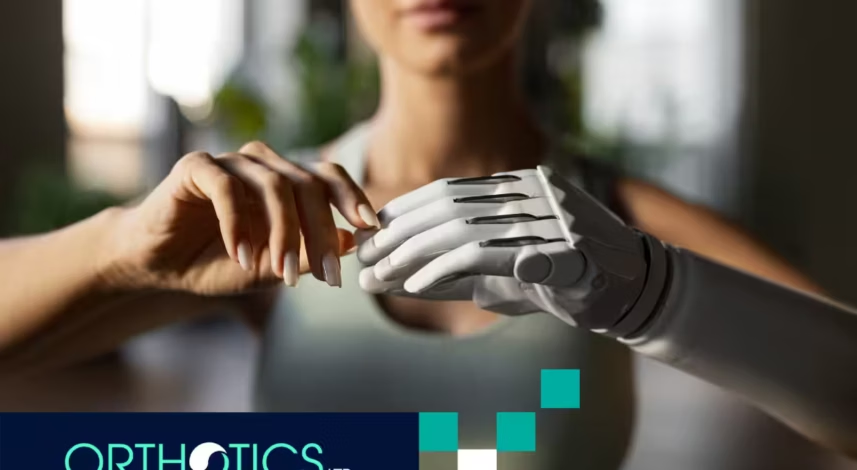
The human hand is a marvel of engineering, capable of delicate tasks like writing or threading a needle, as well as strength-based actions like lifting and gripping. Losing hand or finger function, whether due to trauma, congenital conditions, or disease, significantly impacts independence and quality of life. Fortunately, advances in prosthetic hands and fingers are reshaping possibilities, giving users enhanced dexterity, control, and confidence.
This article explores the latest innovations, real-life outcomes, and future directions in prosthetic hand technology, illustrating how these devices are restoring function and improving everyday life.
The Evolution of Prosthetic Hands
Historically, prosthetic hands were simple mechanical devices, often designed more for appearance than function. Basic hooks or static models provided limited usability, allowing for only rudimentary tasks.
Key Milestones:
- Body-powered prosthetics: Early prosthetic hands relied on cables and harnesses controlled by shoulder or arm movement. While functional, these devices required significant effort and offered limited precision.
- Myoelectric prosthetics: Introduced in the late 20th century, these devices detect electrical signals from residual muscles, enabling more natural hand movements. Users can open, close, and sometimes articulate individual fingers.
- Multi-articulating hands: Modern devices now include multiple joints, allowing complex motions like pinching, grasping, and typing. These advancements significantly increase independence and task versatility.
Understanding Myoelectric Technology
Myoelectric prosthetics use sensors to detect electrical signals generated by voluntary muscle contractions in the residual limb. These signals are then converted into movements of the prosthetic hand.
Benefits of Myoelectric Hands:
- Natural movement: Allows users to control individual fingers and grip patterns.
- Reduced fatigue: Unlike body-powered devices, they require minimal physical effort.
- Aesthetic appeal: Sleeker designs often resemble the natural hand.
Case Study: A 32-year-old patient with a transradial amputation regained the ability to play guitar using a multi-articulating myoelectric hand. Through targeted training and rehabilitation, the patient transitioned from struggling with basic grips to performing chord transitions with confidence.
Sensory Feedback and Prosthetic Hands
One of the most exciting areas in prosthetics is sensory feedback, where users can “feel” objects via the prosthetic. Sensors detect pressure or texture, sending signals to the nervous system or residual limb.
Advantages Include:
- Preventing drops and slips
- Allowing delicate manipulation of fragile objects
- Reducing phantom limb pain through tactile feedback
Example from Practice: We’ve observed that patients using sensory-enabled fingers can adjust grip force automatically when holding objects like eggs or glasses, drastically reducing accidents compared to traditional prosthetics.
Customization for Individual Needs
No two users are the same. Prosthetic hands can be customized based on:
- Level of amputation (partial finger, transradial, transcarpal)
- Daily activities (typing, cooking, sports)
- Personal comfort and aesthetics
Common Prosthetic Hand Options
| Type | Features | Best For |
|---|---|---|
| Body-Powered | Hook or simple hand, cable-operated | Basic daily tasks, durability |
| Myoelectric | Muscle signal-controlled, individual finger movement | Daily life activities, dexterity |
| Multi-articulating | Multiple joints, lifelike movement | Complex tasks, sports |
| Sensory Feedback Enabled | Detects pressure, vibration, or texture | Precision tasks, fragile objects |
| Pediatric Prosthetics | Lightweight, adaptable | Children’s growth & play |
Example from Practice: Children receiving custom prosthetic fingers for congenital hand differences often show improved fine motor development and social confidence, particularly in school and play settings.
Rehabilitation and Training
Even the most advanced prosthetic requires training. Rehabilitation focuses on:
- Muscle strengthening
- Learning intuitive control of myoelectric signals
- Task-specific practice (e.g., cooking, writing)
Example from Practice: One patient regained the ability to independently prepare meals after a 12-week therapy program focused on grip coordination, demonstrating how therapy complements advanced technology.
Future Innovations
The future of prosthetic hands is promising, with ongoing research in:
- Direct neural interfaces: Connecting prosthetics directly to the nervous system for real-time control
- Soft robotics: Creating hands with natural flexibility and compliance for safer interaction
- Artificial skin: Integrating temperature and texture sensing for more lifelike experiences
These advancements aim not only to restore function but also to provide the experience of a natural hand, bridging the gap between technology and biology.
Everyday Impact
Advanced prosthetic hands are more than technical marvels—they transform lives:
- Independence: Users regain the ability to cook, dress, and perform daily tasks without assistance.
- Confidence: A functional hand improves social interaction and self-esteem.
- Recreation: Prosthetics now enable hobbies like sports, music, and art.
Example from Practice: In a session with a former office worker, a multi-articulating hand allowed her to resume typing, drawing, and gardening. She reported feeling “like herself again,” highlighting the profound emotional and practical benefits of prosthetic restoration.
Final Thoughts
The field of prosthetic hands and fingers has advanced dramatically, offering users enhanced dexterity, sensory perception, and life-changing independence. While technology continues to evolve, the combination of innovation, customization, and rehabilitation remains the cornerstone of success.
For those exploring prosthetic options, partnering with experienced professionals ensures a tailored approach that maximizes both function and comfort. At Orthotics Ltd., our team supports individuals through every step, from assessment and fitting to therapy, helping restore hand function and transform daily life. Contact us today!
Frequently Asked Questions
1. How long does it take to adapt to a prosthetic hand?
Adaptation varies but generally ranges from a few weeks to several months. Training and therapy are essential for achieving proficiency.
2. Can prosthetic hands restore fine motor skills like writing or typing?
Yes, modern multi-articulating hands allow precise finger movements, enabling many fine motor tasks with practice.
3. Are prosthetic hands covered by insurance?
Many insurance plans cover prosthetic hands, particularly for medical necessity. Coverage depends on your policy.
4. What is the difference between body-powered and myoelectric prosthetics?
Body-powered prosthetics use cables and physical effort to move the device, while myoelectric devices detect muscle signals for more natural control.
5. Can children use prosthetic fingers?
Absolutely. Pediatric prosthetics are lightweight and adaptable, supporting growth, play, and fine motor development.
Sources:
- https://pmc.ncbi.nlm.nih.gov/articles/PMC4968852/
- https://pmc.ncbi.nlm.nih.gov/articles/PMC7324654/
- https://www.physio-pedia.com/Amputations
- https://www.physio-pedia.com/Prosthetic_rehabilitation
- https://news.uchicago.edu/story/making-prosthetic-limbs-feel-more-real-brain-computer-interfaces
- https://pmc.ncbi.nlm.nih.gov/articles/PMC11278702/
