

Orthotics for Flat Feet: When Custom Support Actually Helps
Key Highlights
- Flat feet (also called pes planus or fallen arches) are common and often painless, but when they cause symptoms, the pain frequently shows up in the knees, hips, or lower back, not just the feet.
- There’s a critical difference between flexible flat feet (arch appears when sitting) and rigid flat feet (no arch in any position), and only one of them typically responds well to orthotics.
- Telltale signs that orthotics for flat feet may help include arch pain, heel pain, ankles rolling inward (overpronation), and shoes that wear out unevenly on the inner edge.
- Over-the-counter insoles can work for mild, occasional discomfort, but custom orthotics for flat feet are the better long-term investment when symptoms are persistent or interfere with daily activity.
- Most patients feel meaningful relief within 2–4 weeks of wearing properly fitted custom orthotics, with full benefits emerging at the 8–12-week mark.
- The fitting process matters: a thorough evaluation includes a foot scan or cast, gait analysis, and follow-up adjustments to fine-tune the fit.
The Pain That Doesn’t Stay in Your Feet
Plenty of people walk around on flat feet their whole lives and never give it a second thought. No pain, no problems, no need for intervention. But for the people whose flat feet do cause issues, the discomfort often shows up in places they’d never expect: aching knees after a long walk, hips that feel tight by the end of the day, or a lower back that throbs after standing at a counter for an hour.
That’s the tricky thing about fallen arches. The feet are the foundation of how you move, and when that foundation isn’t supporting weight the way it should, the consequences travel upward through the body. By the time someone connects their back pain to their feet, they’ve often spent months, sometimes years, treating the symptom instead of the source.
This post breaks down when orthotics for flat feet genuinely help, when they don’t, and what to realistically expect if you’re considering custom support.
Flat Feet 101: What’s Actually Going On Down There
Flat feet, fallen arches, pes planus — these all describe the same thing. The arch on the inside of your foot, which normally curves upward off the ground, has either never fully developed or has gradually collapsed over time.
The arch isn’t just an anatomical detail. It’s a shock absorber. Every time your heel strikes the ground, the arch flexes slightly, distributing impact across the foot before pushing off again. It also acts as a lever for forward motion and helps stabilize the ankle, knee, and hip during gait.
When the arch is flattened, three things tend to happen:
- The shock that would have been absorbed by the arch instead travels up the leg.
- The ankle tends to roll inward (overpronation), changing the alignment of the knee.
- The muscles and tendons of the foot work harder to compensate, leading to fatigue and inflammation.
Some people are born with flat feet and adapt perfectly well. Others develop them later in life due to injury, weight gain, pregnancy, or simple wear and tear on the posterior tibial tendon, the structure that holds the arch up. The flat foot itself isn’t the problem. The symptoms are.
Flexible vs Rigid Flat Feet: The Distinction Most Articles Skip
Here’s the part that gets glossed over in most online articles, and it matters more than almost anything else when deciding whether orthotics will help.
- Flexible flat feet are the most common type. When the person is sitting with their feet dangling, an arch is visible. When they stand up and put weight on the foot, the arch flattens out and disappears. The structure is there—it just gives way under load. This is the type that tends to respond very well to orthotics, because supportive devices can essentially hold the arch in the position it naturally wants to assume when unloaded.
- Rigid flat feet are different. There’s no arch present whether the person is sitting, standing, or lifting the foot in the air. The bones of the foot have either fused, developed unusually, or undergone changes that prevent any arch from forming. Rigid flat feet require a different approach, sometimes accommodative orthotics designed to cushion rather than correct, and in some cases referral to a specialist for further evaluation.
| Feature | Flexible Flat Feet | Rigid Flat Feet |
|---|---|---|
| Arch visible when seated? | Yes | No |
| Arch visible when standing? | No | No |
| Foot mobility | Normal | Limited |
| Common in | Children, adults with adult-acquired flatfoot | Less common; often structural or congenital |
| Response to corrective orthotics | Generally good | Limited; usually requires accommodative devices |
| Typical approach | Custom arch support, motion control | Cushioning, specialist evaluation |
The simple at-home test: sit in a chair with your foot lifted. If you see an arch. Now stand up. If the arch disappears, you likely have flexible flat feet — the type orthotics are most effective for.
Symptoms That Suggest Orthotics Could Help
Not every flat foot needs intervention. But the following symptoms are strong indicators that custom support could make a real difference:
- Arch pain that worsens with activity or after long days on your feet
- Heel pain, especially in the morning when you first step out of bed (often a sign of plantar fasciitis, which is closely linked to fallen arches)
- Ankles rolling inward when you walk or run, also known as overpronation
- Knee pain, particularly on the inner side of the kneecap
- Lower back stiffness or pain after extended standing or walking
- Shoes wearing out unevenly, with the inner edges of the heels and soles breaking down faster than the outer edges
- Shin splints during exercise
- Tired, achy feet by the end of the day, even when nothing dramatic has happened
In our sessions, we’ve seen patients who came in convinced they had a knee problem or a back problem, only to discover that their gait, driven by uncorrected overpronation, was the underlying culprit. One patient, a nurse working twelve-hour shifts, had spent over a year treating chronic lower back pain with stretching and physical therapy with minimal improvement. A gait analysis revealed significant inward collapse of both ankles. Within six weeks of wearing properly fitted fallen arches insoles, her back pain reduced by more than half, and within three months, it was a non-issue. The back was never the source — the feet were.
Over-the-Counter Insoles vs Custom Orthotics: An Honest Take
Not everyone with flat feet needs custom orthotics, and pretending otherwise would be dishonest. For mild, occasional discomfort in someone with flexible flat feet, a quality over-the-counter insole can provide enough support to make a real difference. They’re affordable, accessible, and worth trying first if your symptoms are minor.
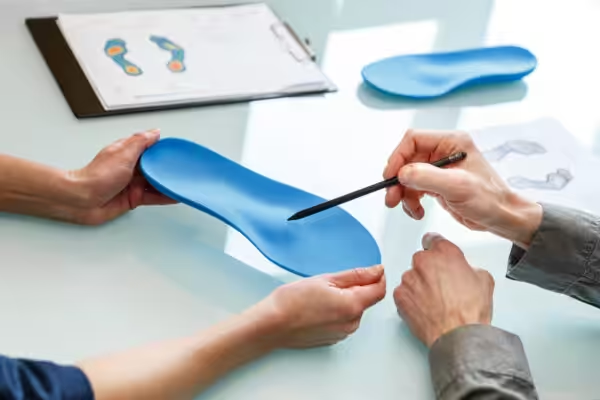
Over-the-counter insoles tend to fall short, however, when:
- Symptoms are persistent rather than occasional
- The flat foot is moderate to severe
- There’s significant overpronation
- The patient has secondary issues like knee, hip, or back pain
- Off-the-shelf options haven’t provided relief after a reasonable trial
- The person spends long hours on their feet for work
The best orthotics for flat feet in these cases are custom-built. They’re shaped to the specific contours of your foot, with arch height, heel cup depth, and posting angles tailored to your gait, not the averaged dimensions of a generic shoe insert.
What Custom Orthotics Actually Do for Flat Feet
Custom orthotics for flat feet work in a few specific ways:
- Flat feet and arch support sized to your foot. Generic insoles place the arch peak in a position that statistically works for most people. Custom devices place it exactly where your arch sits, providing support without pressure points.
- Heel cup positioning. A deep, well-positioned heel cup keeps the heel from rolling inward and stabilizes the foot from the first moment of ground contact.
- Addressing overpronation. Through subtle wedging (called “posting”) under the heel and forefoot, custom orthotics can gently guide the foot into a more neutral position throughout the gait cycle, reducing the cascade of misalignment that travels up the leg.
- Even pressure distribution. A well-made orthotic spreads load across the entire foot rather than letting pressure concentrate at the heel, ball, or arch.
The result, for the right candidate, is a foot that does what it’s supposed to do: absorb shock, propel you forward, and stay aligned with the rest of your body.
The Fitting Process: What to Expect
A proper fitting isn’t a five-minute affair. The process typically looks like this:
- Initial evaluation. A discussion of symptoms, medical history, footwear habits, and activity level.
- Foot scan or casting. A 3D scan, foam impression, or plaster cast captures the exact shape of your foot in a neutral position.
- Gait analysis. Watching how you walk, sometimes on a treadmill, sometimes with pressure-mapping technology, reveals patterns a static exam can miss.
- Fabrication. The orthotic is built based on the data gathered, usually over one to three weeks.
- Fitting and break-in guidance. When the orthotics arrive, you’ll be coached on how to gradually increase wear time.
- Follow-up adjustments. Minor tweaks are normal. A good clinic builds these into the process rather than charging extra for them.
If a provider offers to make custom orthotics without watching you walk, ask why. Gait analysis isn’t optional for good results.
Realistic Timeline: When You’ll Feel the Difference
This is where honesty matters. Custom orthotics aren’t a same-day fix. Your feet have spent years, possibly decades, moving in a particular pattern, and they need time to adapt to new support.
Most people notice meaningful relief within 2–4 weeks of consistent wear. Full benefits, including resolution of secondary issues like knee or back pain, typically emerge at the 8–12-week mark.
Some mild soreness during the break-in period is normal, particularly in muscles that have been underused. If pain worsens significantly or new pain develops, that’s a sign to return to your provider for adjustments. For more on this, see our post on why your orthotics hurt.
If you’re weighing options, our deep dive on custom orthotics vs over-the-counter insoles covers the cost-benefit tradeoffs in more detail. You can also learn more about our orthotics services and how they’re tailored to specific conditions.
Get a Proper Evaluation for Your Flat Feet
Flat feet don’t always need treatment, but when they cause pain in your feet, knees, hips, or back, the right support can change the way you move and feel every day. The key is a proper evaluation: identifying whether your flat feet are flexible or rigid, understanding your gait, and choosing the level of support that actually matches your situation rather than guessing with a drugstore insert.
At Orthotics Ltd., we specialize in custom orthotics for individuals, even runners with flat feet, designed and fitted by experienced clinicians who take the time to analyze your gait, scan your feet accurately, and follow up to make sure the fit is right. We work with patients across the full spectrum — from young adults dealing with overpronation for the first time to older patients managing adult-acquired flatfoot to athletes looking for performance-supporting fallen arches insoles. Visit our New York clinics for a flat feet evaluation and find out whether custom support could be the missing piece in your recovery. Contact us today to schedule your appointment.
Frequently Asked Questions
1. Can flat feet be cured?
Not in the strict sense. The structure of the foot doesn’t fundamentally change in adults. What can change is whether your flat feet cause symptoms. With proper support, strengthening exercises, and footwear changes, many people go from significant pain to no pain at all — even though the foot itself still looks flat.
2. Do kids with flat feet need orthotics?
Most children have flat feet until around age six because their arches are still developing. Intervention generally isn’t needed unless the child experiences pain, fatigue, avoids physical activity, or has rigid flat feet. If a child complains consistently about foot, leg, or knee pain, an evaluation is worthwhile — but most cases resolve on their own.
3. Why do my flat feet only hurt sometimes?
Symptoms often depend on cumulative load. A short walk on cushioned floors in supportive shoes may cause no issues at all. The same feet on hard floors, in unsupportive shoes, after a long day of standing? That’s when pain shows up. Symptoms tend to track with activity level, footwear, weight changes, and overall fatigue.
4. Are orthotics for flat feet covered by insurance?
Coverage varies widely by plan. Many insurance providers cover custom orthotics when prescribed for medical conditions such as plantar fasciitis or posterior tibial tendon dysfunction. It’s worth verifying coverage before your appointment.
5. How long do custom orthotics last?
A well-made pair typically lasts three to five years, depending on activity level, body weight, and how often they’re worn. The top cover may need to be replaced sooner, but the underlying shell holds up for years.
Sources:
- https://my.clevelandclinic.org/health/diseases/flat-feet-pes-planus
- https://www.health.harvard.edu/diseases-and-conditions/fallen-arch-a-to-z
- https://www.hss.edu/health-library/conditions-and-treatments/list/flatfoot
- https://www.foothealthfacts.org/conditions/flexible-flatfoot
- https://pmc.ncbi.nlm.nih.gov/articles/PMC5175026/
